LISTEN · NOTICE · SAY IT
Make useful sound differences easier to hear
Start with a short listening check, or choose a sound you want to practise. Each lesson connects a sound contrast to everyday words and a sentence you can use.
These examples use an American English practice model. Other accents can make different distinctions.
Choose a soundChoose a sound to explore
Tap a symbol to see its position guide, hear a familiar word and practise the contrast.
Three synthetic US English voices. Replaying a quiz choice keeps the same voice.
Ship and sheep
/ɪ/ and /i/
/ɪ/ as in ship

- Tongue slightly lower
- Relaxed lips
- Open airflow
/i/ as in sheep
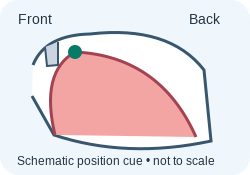
- Tongue high at the front
- Lips unrounded
- Open airflow
Try the mouth position
For /ɪ/, relax the tongue slightly lower. For /i/, lift it toward the front. Both use an open air passage.
Listen for: Listen for vowel quality, not just length.
Try the sound in new words
Two listening choices using a different word pair. These words are new to this lesson, not necessarily new to you.
Use it in a sentence
The ship leaves at six.
I live near the station.
Say the sentence once, pause, then repeat it with one detail changed.
Full and fool
/ʊ/ and /u/
/ʊ/ as in full
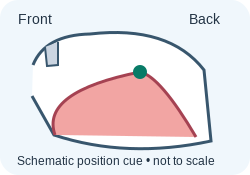
- Tongue slightly lower
- Lips loosely rounded
- Open airflow
/u/ as in fool

- Tongue raised
- Lips rounded
- Open airflow
Try the mouth position
For /ʊ/, keep the tongue a little lower and the lips loosely rounded. For /u/, raise the tongue and round the lips.
Listen for: Keep the vowel clear without adding another syllable.
Try the sound in new words
Two listening choices using a different word pair. These words are new to this lesson, not necessarily new to you.
Use it in a sentence
The pool is full today.
Pull the door toward you.
Say the sentence once, pause, then repeat it with one detail changed.
Bed and bad
/ɛ/ and /æ/
/ɛ/ as in bed

- Tongue at mid-front
- Jaw partly open
- Open airflow
/æ/ as in bad

- Tongue lower at the front
- Jaw more open
- Open airflow
Try the mouth position
Lower the jaw a little more for /æ/ than /ɛ/. Keep the tongue toward the front for both.
Listen for: Notice the vowel change while the consonants stay the same.
Try the sound in new words
Two listening choices using a different word pair. These words are new to this lesson, not necessarily new to you.
Use it in a sentence
The spare bed is ready.
Put the pan on the table.
Say the sentence once, pause, then repeat it with one detail changed.
West and vest
/w/ and /v/
/w/ as in west

- Tongue raised toward the back
- Round lips, then release
- Smooth voiced glide
/v/ as in vest

- Tongue relaxed
- Upper teeth touch lower lip
- Continuous voiced friction
Try the mouth position
For /w/, round the lips and glide into the vowel. For /v/, touch the lower lip lightly with the upper teeth and keep your voice on.
Listen for: With /v/, listen for friction; /w/ is a smooth glide.
Try the sound in new words
Two listening choices using a different word pair. These words are new to this lesson, not necessarily new to you.
Use it in a sentence
The west entrance is open.
Would you like some wine?
Say the sentence once, pause, then repeat it with one detail changed.
Right and light
/r/ and /l/
/r/ as in right

- Tongue raised without ridge contact
- Lips may round slightly
- Voice on; no extra vowel
/l/ as in light

- Tip touches behind upper teeth
- Lips relaxed
- Air passes around tongue sides
Try the mouth position
For initial /l/, touch the tongue tip to the ridge behind the upper teeth. For American /r/, keep the tongue away from that ridge.
Listen for: Compare the beginning of each word without adding a vowel.
Try the sound in new words
Two listening choices using a different word pair. These words are new to this lesson, not necessarily new to you.
Use it in a sentence
Turn right at the light.
The load is ready for the road.
Say the sentence once, pause, then repeat it with one detail changed.
Thin and tin
/θ/ and /t/
/θ/ as in thin

- Tip near or lightly between teeth
- Lips relaxed
- Keep air moving; voice off
/t/ as in tin

- Tip briefly touches tooth ridge
- Lips relaxed
- Stop air, then release
Try the mouth position
For /θ/, let air pass by the tongue near the teeth. For /t/, briefly stop the air behind the upper teeth, then release.
Listen for: Listen for continuing air in /θ/ and a brief stop in /t/.
Try the sound in new words
Two listening choices using a different word pair. These words are new to this lesson, not necessarily new to you.
Use it in a sentence
Put three cups beside the tin.
That tree is near the entrance.
Say the sentence once, pause, then repeat it with one detail changed.
Sip and ship
/s/ and /ʃ/
/s/ as in sip
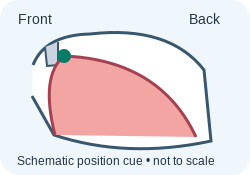
- Tongue near the tooth ridge
- Lips mostly unrounded
- Narrow continuous airflow
/ʃ/ as in ship

- Tongue slightly farther back
- Lips may round a little
- Broader continuous airflow
Try the mouth position
For /s/, keep the tongue nearer the tooth ridge. For /ʃ/, move it slightly farther back; the lips may round a little.
Listen for: Listen for the brighter /s/ and the lower, broader /ʃ/.
Try the sound in new words
Two listening choices using a different word pair. These words are new to this lesson, not necessarily new to you.
Use it in a sentence
Take a sip before you speak.
She can see the ship.
Say the sentence once, pause, then repeat it with one detail changed.
Use these sounds in connected speech →
Today’s practice · Word families and roots · Word patterns across languages
About the audio and practice results
Audio uses three hosted synthetic US English practice voices, generated from fixed lesson text. The position drawings are simplified cues, not anatomical demonstrations. Browser speech is a fallback for original-voice examples. Alternate-voice exercises require their matching recording. Listening results describe the choices you made, not your spoken pronunciation. Speaking practice is self-reported. Paid speech evaluation is coming soon.
Voice: Piper en_US-ljspeech-high, trained on the public-domain LJ Speech dataset. Voice source · Dataset information · Report an audio issue
Alternate voices: Piper en_US-libritts_r-medium, speaker IDs 0 and 100. Model card. Source: LibriTTS-R, Koizumi and colleagues, licensed CC BY 4.0. ProudAccent generated these synthetic practice clips; they are not original audiobook recordings or an endorsement.
Hear regional pronunciation choices
Compare the available American and British models on these word pages. Regional playback depends on a matching voice being available.
Schedule → · Route →